
In the high-stakes arena of North American municipal and state-level politics, every decision is scrutinized, and every public appearance is a test of authority. As an elected official or aspiring leader, you are constantly managing the delicate tension between transparency and decisiveness. However, many leaders focus entirely on their policy platforms while leaving their most powerful tool—their voice coaching—to chance.
The reality is that your vocal signature is the primary filter through which your constituents judge your competence. Before they weigh the logic of your arguments, they have already evaluated your presence and trustworthiness through the sound of your conviction.
The presidential sound: the science of acoustic leadership
The impact of voice on public perception is not merely a matter of opinion; it is a biological imperative rooted in evolutionary psychology.
Research conducted by political scientist Casey Klofstad on what he terms the “presidential sound” reveals that voters across the political spectrum possess subconscious, deep-seated preferences for specific vocal characteristics. We are biologically wired to associate lower, resonant frequencies with stability, size, and physical dominance—traits historically linked to leadership.
When you speak at a town hall, a televised debate, or during a council meeting, you are triggering these ancient reflexes in your audience. A voice that is strained, thin, or erratic does not just sound nervous; it signals a perceived lack of the biological markers of leadership that your constituents instinctively seek.
The historical precedent: Margaret Thatcher’s vocal evolution
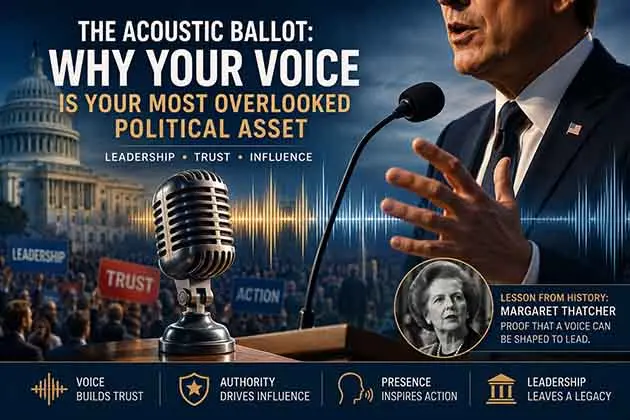
If you believe that your voice is a fixed trait you are stuck with, you need only look at the most iconic political vocal transformation in history: Margaret Thatcher.
During her rise to power in an environment dominated exclusively by male politicians, Thatcher recognized that her natural, higher vocal register was being dismissed by opponents as “shrill” or overly emotional. She did not accept this as an unchangeable limitation.
Instead, she underwent rigorous vocal coaching to deliberately lower her pitch and master the cadence, authority, and rhythm of her delivery. By doing so, she projected an image of unbreakable resolve, effectively leveling the playing field in a highly competitive environment. Thatcher understood what many modern politicians forget: the voice is a flexible instrument that can be sculpted to meet the demands of the political moment.
The double-edged sword: why vocal mastery is a requirement
The voice has a clear impact on public trust, for better or for worse. In the modern political arena, where authenticity is the primary currency, a discordant or weak voice can undermine your most well-reasoned policies and erode confidence.
Conversely, a voice that is mastered, controlled, and resilient serves as a stabilizer during crises. This is not about “faking” a persona; it is about aligning your internal conviction with your physical delivery so your message lands with the intended impact.
Whether you are addressing constituents in New York, Chicago, Los Angeles, or a rural county, your voice must convey that you are in full possession of your faculties and in command of the situation. If you are struggling with vocal fatigue after a long day of campaigning, or if your voice loses its core when the questioning gets tough, you are actively losing political influence.
A strategic imperative for elected officials
Vocal mastery is a professional discipline, not an optional soft skill. Whether you are addressing a skeptical appropriations committee or rallying your constituents, your ability to sustain your presence through your voice is what determines your long-term longevity.
True leadership is not just about what you say; it is about how you sound when you say it. In the echo chamber of public office, make sure your voice resonates with the authority and empathy your role demands. For those looking to bridge the gap between policy and presence, specialized resources provide the physiological tools necessary for long-term political impact.