
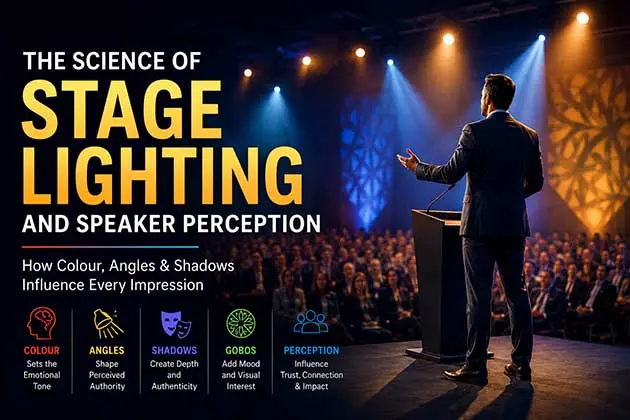
A speaker steps onto the podium. The room is quiet, every eye fixed forward. But before a single word leaves their mouth, the audience has already begun forming a judgment—authoritative or approachable, energetic or calm, trustworthy or… not. That split‑second impression isn’t magic. It’s lighting.
Event planners rarely hand their AV crew a lighting brief that goes beyond “make sure we can see the speaker.” Yet research in colour psychology, shadow science, and production design reveals that strategic lighting physically alters how an audience receives a speaker.
The right wash of colour, the precise angle of a key light, even the texture of a subtle gobo pattern—these aren’t just aesthetic choices. They’re psychological levers.
This article translates that science into a concrete lighting brief any event planner can hand to their AV team, ensuring every speaker stands in the best possible light.
The Psychology of Colour on the Podium
Colour on stage isn’t decoration. It’s a priming tool that sets the audience’s emotional baseline before the speaker even opens their mouth.
Warm‑spectrum hues—reds, oranges, ambers—hit the retina and immediately trigger a perception of intensity and energy, producing stronger emotional responses. Cool hues like blues and greens, on the other hand, coax the brain toward states of calm and peace (The Criterion, 2026).
That’s not just poetry. Researchers have verified a specific colour‑emotion map that AV designers rely on:
- Red – passion, urgency, excitement, even danger. It raises arousal and heart rate.
- Blue – calm, trust, sadness, detachment. Low arousal, but when used in corporate keynotes, it screams professionalism and reliability.
- Amber – warmth, nostalgia, intimacy. It’s a comfort colour, and it flatters skin tones, which is why it’s a staple for live broadcasts and video recording.
- Purple – luxury, mystery, creativity. At low lux levels, it can even trigger gamma brain activity.
- Green – balance, nature, renewal. It reduces tension and restores equilibrium.
Here’s where it gets even more interesting: warm colours appear to advance toward the audience, while cool colours recede. In the hands of a good lighting designer, that perceptual illusion creates depth, draws the eye to the speaker, and makes the stage feel larger than life (MARS LED Stage, 2024).
For speeches and conferences, the sweet spot for colour temperature on the face is 4000K–5000K—clean, natural, and flattering. If the moment calls for something more emotional (a dramatic story, a heartfelt anecdote), dropping to 2700K–3200K wraps the speaker in a warm, intimate glow.
And a simple pro move: layer a warm face light at around 3200K with a cooler backlight at 5600K. That contrast separates the speaker from the backdrop, adding cinematic depth without a single word.
So before you ever think about what a speaker will say, ask: what colour are they standing in? The answer will quietly shape everything the audience feels.
Illumination Angles and the Perception of Authority
If colour sets the emotional mood, the angle of the light sculpts the face—and with it, the audience’s gut‑level judgment of the speaker’s character. This isn’t speculation. Peer‑reviewed research has shown that the position of a spotlight physically alters ratings of trustworthiness, dominance, and attractiveness.
Take split lighting, where a light is placed at a hard 90° to one side of the face. Sure, it boosts dominance scores. But it also significantly drags down attractiveness and trustworthiness.
Rembrandt lighting, on the other hand—where the key light sits at roughly a 75° angle, creating that classic triangle of light under the eye—consistently increases both attractiveness and trustworthiness.
And when the speaker’s gaze is directed straight at the audience, trust scores shoot up even more (Frontiers in Psychology, 2022).
In plain English: if you want your speaker to come across as commanding yet approachable, you don’t blind them from the side. You light them from the front, with slight off‑axis angles that mimic the natural light our brains have learned to trust.
Professional AV crews already know this. They recommend front lighting with diffusion and multiple sources to avoid harsh shadows, keeping faces clearly visible and audience attention locked on the speaker (Stage Connections, 2024).
High side lighting, hung at 30–60° overhead, accentuates the top of the head, neck, and shoulders, pulling extra focus to facial expressions (Stage Electrics). Side lighting sculpts faces and makes a speaker look dynamic. Backlighting, used sparingly, creates silhouettes that add drama and impact (Innovation Lighting, 2025).
For a foolproof setup, three‑point lighting—two fixtures in front, one in back—removes most shadows from the audience’s perspective and is ideal for speakers and performers alike (One Way Event Productions).
The takeaway? The angle of light on a speaker’s face directly translates to how authoritative yet approachable they appear. Choose your angles like you’d choose your words: deliberately.
Shadows, Gobos, and Visual Depth
We tend to think of shadows as problems to be eliminated. But in stage lighting, controlled shadows are essential.
Cast shadows give the audience critical information about where the speaker is in the scene, making the presentation feel real and three‑dimensional (The Criterion, 2026). A speaker floating in flat, shadowless light looks artificial—like a hologram, not a person.
Beyond the speaker, the backdrop matters. Gobos—templates that project patterns—can throw subtle textures like foliage, abstract geometries, or organic breakup patterns onto the stage.
These add ambiance, mood, and thematic context without distracting from the speaker. A well‑chosen breakup gobo on a rear wall gives the eye something to rest on, making the whole stage feel designed (Revelation Productions, 2023).
Depth comes from separation. Backlighting separates the speaker from the background, making them pop forward as a multi‑dimensional figure. Side lighting adds contour and dynamism. But be careful: what looks dramatic in person can become a nightmare on camera.
For livestreams and video recordings, four‑point lighting (adding a fourth fixture) eliminates all shadows, ensuring the speaker looks clean and professional on screen.
The balancing act: controlled shadow adds gravitas. Uncontrolled shadow—especially hard side shadows—can make a speaker look untrustworthy, even sinister. Event planners need to treat shadows as a conscious design choice, not an accident.
The Technical Brief: Colour Temperature, CRI, and Broadcast‑Ready Lighting
Now, let’s translate all that psychology into hard specifications you can hand to an AV team. Because if your event includes a livestream or recording, the technical bar rises quickly.
First, colour rendering. The Colour Rendering Index (CRI) measures how faithfully a light source reproduces colours compared to natural light.
For live events with a livestream or recording component, lighting fixtures must meet a minimum CRI of 90. For broadcast productions, you need TLCI (Television Lighting Consistency Index) of 90 or above to ensure accurate skin tones.
The key light on the speaker’s face? Push for CRI 95+ (DCE Productions). Cheap fixtures with poor CRI will turn a carefully crafted look into a muddy, unflattering mess.
Second, colour temperature for broadcast should be calibrated to a neutral 4000K–5600K. That range plays nicely with most cameras without requiring heavy post‑correction (DCE Productions).
Cooler temperatures around 6000K enhance focus and make the stage feel larger, while warmer temperatures down at 2700K create intimacy and nostalgia (Longman Light, 2025). The key is intentionality: choose the temperature that matches the speaker’s message.
Finally, the layering trick. A warm front key (around 3200K) combined with a cool backlight (5600K) and diffused front lighting ensures natural‑looking faces with cinematic depth.
This isn’t just a nice‑to‑have—it’s the difference between a flat, corporate look and a speaker who commands the room (SHEHDS, 2025).
Armed with these specs, you’re no longer just a planner hoping for the best. You’re an informed collaborator who speaks the same language as the production team.
From Theory to Practice: A Sample Lighting Brief for Event Planners
Stage lighting serves six main functions: illumination, focusing attention, forming images and emotions, creating a spatial environment, amplifying dramatic atmosphere, and supporting rhythm through changes in time and space (The Criterion, 2026). Use that framework to design a brief that turns research into reality.
Here’s a one‑page lighting brief you can hand directly to your AV crew:
- Key light: 4000K, CRI 95+, diffused. Position it front-facing at a 45° angle to mimic Rembrandt-style lighting—maximizing trustworthiness and attractiveness while keeping the speaker’s face clearly visible.
- Side/high-side light: Warm amber (~3200K) at 45–60°. This sculpts the face, flatters skin tones, and adds a layer of intimacy without pulling focus.
- Backlight: Cool 5600K. Creates separation between the speaker and the backdrop, adding that three‑dimensional, cinematic depth.
- Gobo/backdrop: A subtle breakup pattern projected onto the background. Avoid logos or overly busy textures that distract during the speech. The goal is texture, not clutter.
- For video/livestream: Add a fourth fixture to achieve four-point lighting and eliminate camera-unfriendly shadows. Specify TLCI ≥ 90 on all fixtures.
When event planners work with a speakers bureau like PDA Speakers to secure top talent, providing this lighting brief — grounded in the best practices for LED par lights — ensures the speaker’s physical presence and authority are amplified exactly as the research prescribes, turning a good booking into a memorable stage moment.
The hand-off from creative vision to technical execution doesn’t have to be a mystery. This brief makes it actionable.
Caveats & Counterpoints
Lighting is a powerful amplifier, but it’s not a magic wand. Overly dramatic split lighting might boost perceived dominance, but it can also tank trustworthiness, so match the lighting style to the speaker’s goals and the event’s tone.
Colour associations aren’t culturally universal. What reads as “professional” in one culture might land differently in another, especially at international events. Venue constraints—think low ceilings, limited rigging points, or restrictive power—will force compromises.
The brief must adapt to physical reality without losing its core principles. And in intimate settings with small audiences, an overly polished broadcast look can feel cold; sometimes simpler, warmer lighting fosters a deeper human connection.
Intentional stage lighting is a tool, not the message. Use it to serve the speaker, never to overshadow them.
Conclusion
Stage lighting is far more than illumination. It’s a psychological amplifier that physically alters how audiences perceive a speaker’s authority, warmth, and energy. The research is clear: colour, angle, and shadow aren’t just aesthetic choices—they’re decisions that shape trust, engagement, and memory.
The sample brief above gives event planners a practical, evidence-based tool to align AV with event goals and speaker messaging.
Treat lighting as a strategic layer, not an afterthought. When you’re ready to book the right keynote speaker for your event, give them the lighting brief that makes every word land with impact.